Model Validations
Model Validations allow you to run automated validations on your model to find any issues or possibilities for
improvements. The validations are implemented with Rules which are checked on each element in your Model. Each rule
has a severity. For example, error-level issues will fail a build, while others are reported without blocking it. The
results
are combined into a report, which can be an HTML report or a JUnit XML report.
The validation rules are packaged as expansion-resources, so different rule sets can be bundled and distributed independently. Rule sets are also extensible: teams can implement their own rules using the same contracts as the built-in ones, and package them the same way.
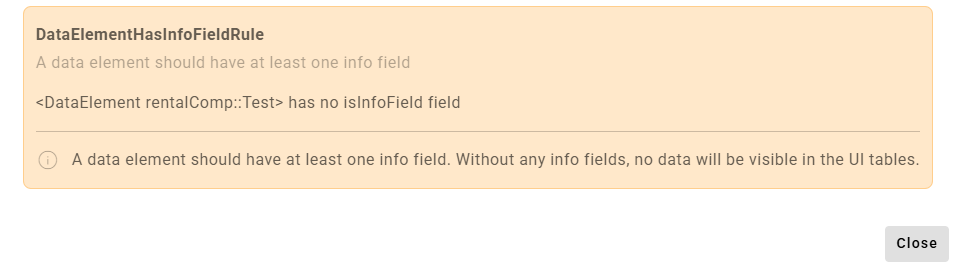
Validations aren't limited to a separate build step — while modelling in µRadiant, the active rule set is already checked live. For example, when building an NS ApplicationNS Application (NSApplication). A pre-built software stack that provides common enterprise application functionality such as CRUD, search, authentication, and business process modeling out of the box., leaving a DataElement without any info fieldsFieldA property of a DataElement expanded to a database column and user interface input element. immediately surfaces a warning, without running anything explicitly:
Documentation Overview
Documentation and guides on the model-validations can be found in the Developer Hub and the Reference Guides: